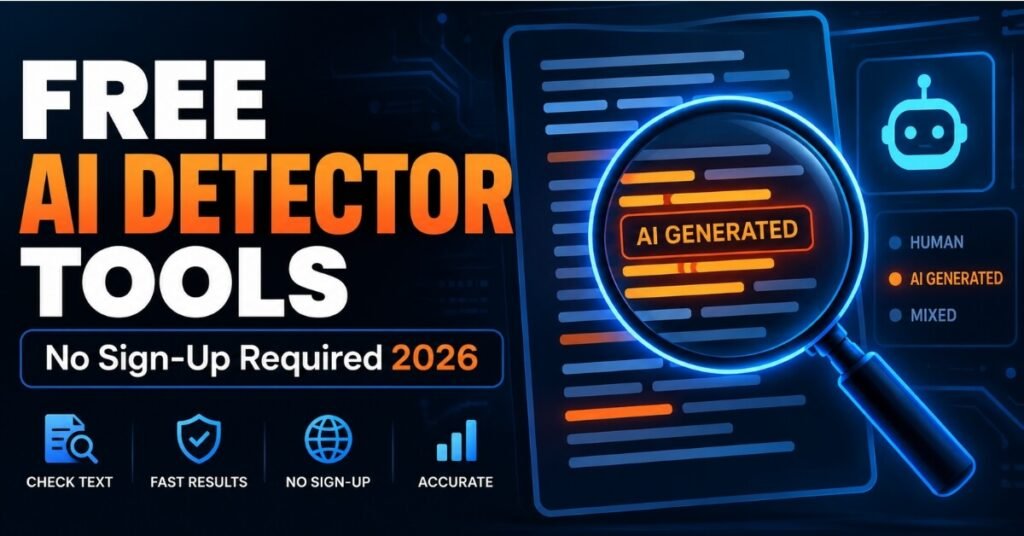
If you’ve ever pasted a paragraph into Google and wondered, “Wait, was this written by a human or a machine?” — you’re not alone. As AI writing tools have exploded in popularity over the past two years, so has the need to verify what’s real and what isn’t. Teachers want to check student submissions before grading them. Editors want to verify freelance work before publishing it. Hiring managers want to confirm that a cover letter reflects the candidate’s actual voice. And everyday readers just want to know if what they’re consuming online — a product review, a news article, a forum post — is genuine or generated.
The good news is you don’t need to create an account or hand over your email address to get answers. A free AI detector no sign up tool lets you paste text and get an instant result — no registration, no credit card, no hoops to jump through.
In this guide, we’ll walk through the best free AI detector no sign up options available in 2026, explain how they actually work under the hood, cover their real-world limitations, and show you how to use them responsibly across different situations — from classrooms to newsrooms to everyday curiosity. Whether you’re a student, a blogger, a hiring manager, or someone who just received a suspicious-sounding email, this list will help you find the right tool for the job without wasting time on signup forms.
Why People Are Searching for AI Content Checkers
The demand for AI content detection has grown rapidly, and it isn’t limited to one type of user. A few clear patterns explain why so many people are now searching for these tools every single day.
Academic integrity is probably the biggest driver. Schools, colleges, and universities are under enormous pressure to verify that submitted essays, research papers, and homework assignments reflect a student’s actual understanding rather than a chatbot’s output. Instructors increasingly run submissions through detection tools before even reading them in detail, and students themselves are running self-checks before hitting submit, just to be safe.
Content quality control is another major factor. Publishers, agencies, and blog owners want to ensure that freelance writers aren’t quietly submitting fully AI-generated drafts without disclosure. Even when AI-assisted writing is allowed, many clients want transparency about how much of a piece was written versus edited.
Trust and transparency matters more to readers than ever before. As AI-generated articles, reviews, and social posts flood the internet, audiences increasingly want to know when content — from product reviews to news coverage — was written by a real person versus a language model.
Scam prevention is a growing use case too. As covered in our guide on how to spot fake AI tools and scams online, AI detectors are often the first line of defense against manipulated, fabricated, or impersonated content circulating on social media and messaging apps.
The problem is that many popular checkers require you to sign up, verify your email, or even enter payment details before you can run a single scan. Some even lock the detailed sentence-by-sentence breakdown behind a paywall after showing you a vague overall score. That’s exactly why tools offering a genuinely free AI detector no sign up experience have become so valuable — they remove all that friction and let anyone check text in seconds, without commitment.
How Do AI Detectors Actually Work?
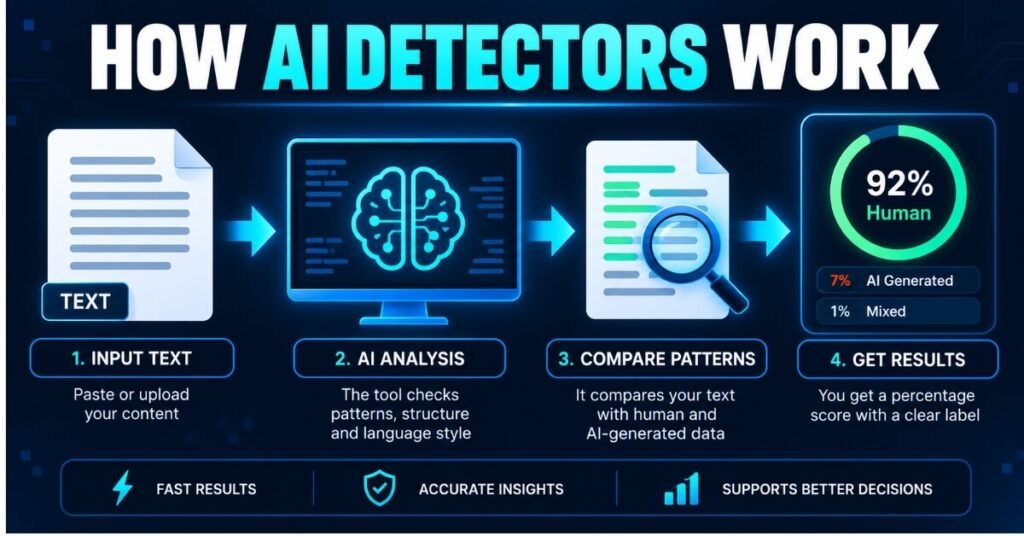
Understanding the mechanics behind these tools helps you interpret their results more intelligently, rather than treating a score as gospel. Most AI detection tools analyze text using a mix of statistical and linguistic patterns rather than “reading” the content the way a human would.
Perplexity is one of the core metrics. It measures how predictable or “smooth” word choices are within a sentence. AI-generated text tends to be more statistically predictable than human writing because language models are, at their core, predicting the most likely next word based on patterns learned from massive datasets. Human writing, by contrast, often includes small quirks, unexpected word choices, and stylistic inconsistencies that make it less predictable.
Burstiness is the second major factor. This refers to the natural variation in sentence length and structure that humans produce almost unconsciously — short punchy sentences mixed with longer, more complex ones. AI-generated text, especially from earlier or less sophisticated models, often lacks this variation and instead produces more uniform sentence lengths throughout a piece.
Sentence-level scoring is a feature found in the more advanced tools. Rather than giving one blanket score for an entire document, these tools break the text into individual sentences or paragraphs and label each chunk as “Human,” “AI,” or “Mixed.” This granular approach is far more useful for writers who want to know precisely which sections need revision, rather than being told a document is “62% AI” without any further context.
It’s worth being upfront about something important: no detector is 100% accurate, and none of them can offer absolute certainty. These tools give you a probability score, not a guaranteed verdict, and heavily edited or “humanized” AI text — text that’s been run through a paraphrasing tool after generation — can sometimes slip past even the most advanced detectors. Still, they remain a useful first-pass check, especially when combined with your own judgment and context about the source.
Top Free AI Detector Tools With No Sign-Up Required
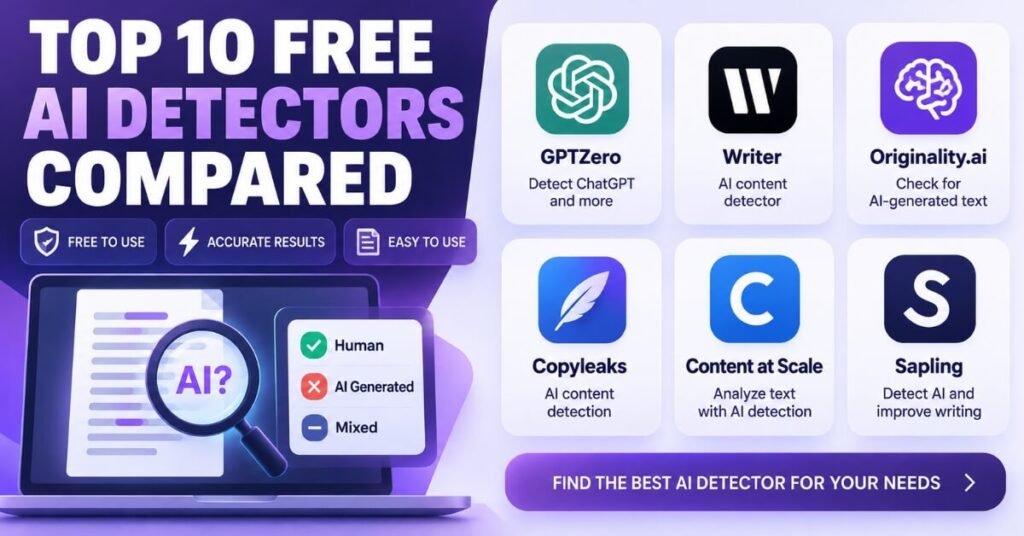
Here’s a detailed breakdown of the most reliable options currently available without requiring registration, ranked roughly by their feature depth and ease of use.
1. GPTinf AI Detector
GPTinf offers sentence-level labeling that separates text into “AI,” “Mixed,” and “Human” categories with highlighted sections. There are no word limits and no account required — you simply paste your text and get a full breakdown showing exactly which parts triggered the AI flag. This level of granular detail makes it especially useful for writers who want to know precisely which sentences to revise rather than rewriting an entire document from scratch.
2. Clever AI Detector
This tool markets itself as a completely free, unlimited checker with no catches. You paste your text, hit scan, and get a score within seconds — no ads, no paywalls, and account creation is entirely optional rather than mandatory. It’s a solid pick if you want something fast, clean, and uncomplicated for quick checks throughout the day.
3. Scribbr AI Detector
Scribbr is widely known in academic circles for its plagiarism and citation tools, and its AI detector follows the same no-hassle philosophy. You don’t need to create an account to start detecting AI-generated content, which makes it a favorite among students checking their own essays before submission, often alongside a plagiarism scan for extra peace of mind.
4. NoteGPT AI Detector
NoteGPT’s checker doesn’t require a login and works across multiple content types, including text generated by popular chatbots like ChatGPT and Gemini. It’s rated highly by users for accuracy and ease of use, and the clean interface means first-time users won’t need a tutorial to get a usable result.
5. Turnitin-Style Detectors (via turnitindetector.ai)
While the official Turnitin platform used by schools requires institutional access and instructor-level accounts, independent tools built around similar detection logic let you paste text and run an instant check without creating any account. This is particularly useful if you want a quick self-check before formally submitting an assignment through an official academic portal, giving you a chance to revise beforehand.
6. Phrasly.AI
Phrasly is completely free, has no signup requirement, and doesn’t impose a strict word limit — meaning you can check long-form documents in a single pass rather than breaking them into smaller chunks and running multiple scans. It’s particularly handy for bloggers and content teams checking entire articles at once instead of paragraph by paragraph.
7. QuillBot AI Detector
QuillBot is best known for its paraphrasing and grammar tools, but its AI detector is equally capable and just as accessible. It checks text generated by popular models and provides a clear AI score along with sentence-level highlights, all without forcing you through a signup wall or asking for payment details upfront.
8. Decopy AI Detector
Decopy’s free checker is built specifically to catch text from a wide range of AI models, not just the most popular ones. It returns an AI score, sentence-by-sentence analysis, and vocabulary insights — giving you noticeably more context than a simple percentage figure, which helps when you need to justify a decision to someone else.
9. Clever AI Humanizer’s Detector Tool
Beyond humanizing text, this platform also offers a built-in detection feature so users can check both directions — whether a piece of text sounds AI-generated in the first place, and separately, whether subsequent edits successfully reduced that likelihood before publishing or submitting.
10. Multi-Model Comparison Checkers
Several newer tools have emerged that specifically check content against outputs from ChatGPT, Claude, and Gemini simultaneously, since different models leave slightly different statistical “fingerprints” in their output. These multi-model checkers are worth trying if a single-model detector gives you an inconclusive or borderline result, since cross-referencing often clears up ambiguity.
How to Choose the Right Free AI Detector No Sign Up Tool
With so many options available, here’s what to actually look for before relying on one for anything important.
Word limit. Some free tools cap you at 500 to 1,000 words per scan, which can be frustrating if you’re checking full-length articles or research papers. If you regularly work with longer documents, look for a tool with a higher or unlimited word allowance instead.
Sentence-level detail. A single overall score is far less useful than a tool that highlights exactly which sentences look AI-generated. This detail lets you make targeted edits rather than second-guessing an entire piece of writing.
Update frequency. AI writing models evolve constantly, and detection tools need to keep pace with new patterns. Choose one that’s actively maintained and regularly updated, since a detector trained only on older AI outputs may struggle with newer, more sophisticated models.
No hidden paywalls. Some tools advertise themselves as “free” but lock the detailed report or sentence highlights behind a signup wall or subscription. Stick to genuinely free AI detector no sign up options that give you the full result upfront, with no surprise restrictions after you’ve already pasted your content.
Privacy policy. Since you’re pasting potentially sensitive or unpublished text, it’s worth checking that the tool doesn’t store or reuse your content for training future models. A quick look at the privacy page before use can save you from unintentionally leaking confidential drafts.
Limitations You Should Know About
Even the best detector tool isn’t perfect, and understanding why matters just as much as knowing which one to use.
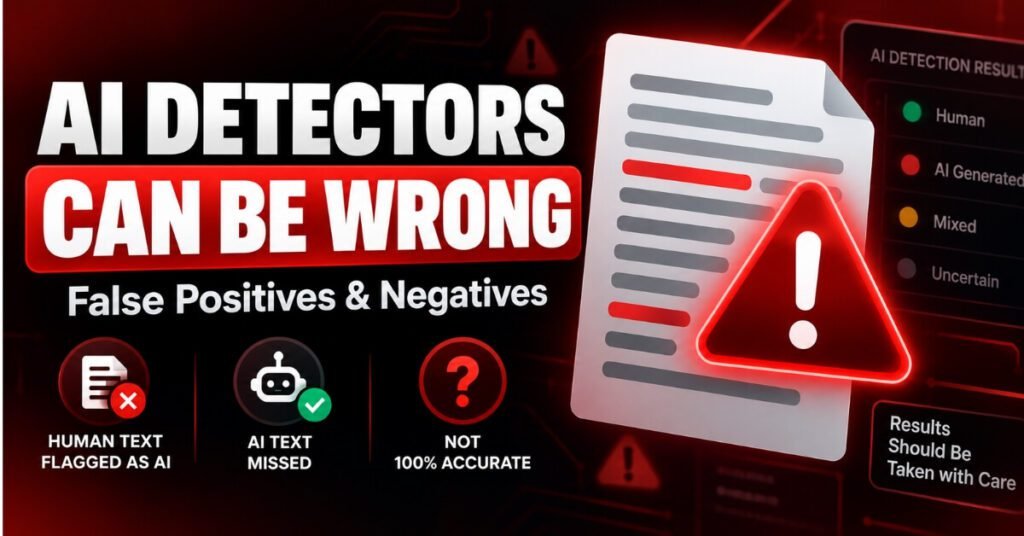
False positives are a real concern. Human writing that’s very formulaic — such as technical documentation, legal boilerplate, or highly structured academic writing — can sometimes be flagged as AI-generated simply because it shares statistical characteristics with machine output, even though a person wrote every word.
False negatives work the other way around. Text that’s been “humanized” through paraphrasing tools, or heavily edited by a human after AI generation, can often bypass detection entirely, since the statistical patterns detectors rely on become diluted or disguised.
Model drift is a technical challenge developers face constantly. As AI writing models improve and change their underlying architecture, older detectors may become less accurate until they’re retrained or updated, creating a temporary blind spot.
No legal weight. A detection score should never be treated as definitive proof in academic disciplinary hearings or legal disputes without additional supporting evidence, since even the most confident tools acknowledge a margin of error.
Organizations like the Content Authenticity Initiative are working on more robust long-term solutions, such as embedding verifiable metadata directly into content at the point of creation, rather than relying purely on after-the-fact text analysis that can be fooled by clever editing.
Using AI Detectors Across Different Situations
Different users apply these tools in different ways, and it’s worth tailoring your approach depending on your situation. Educators, for instance, often benefit from treating a flagged result as a conversation starter rather than an automatic accusation — asking a student to explain their drafting process can reveal more than the score alone. Content buyers and agencies frequently ask writers to share screen recordings or draft history alongside a detection report, since this combination offers far stronger evidence than a single score.
Journalists and fact-checkers sometimes run the same text through two or three different detectors before drawing any conclusions, since results can vary meaningfully between tools built on different underlying models. And everyday readers checking a suspicious email or online post should treat a detector as one signal among several — alongside checking the sender’s identity, looking for factual inconsistencies, and applying basic common sense.
Tips for Using AI Detectors Responsibly
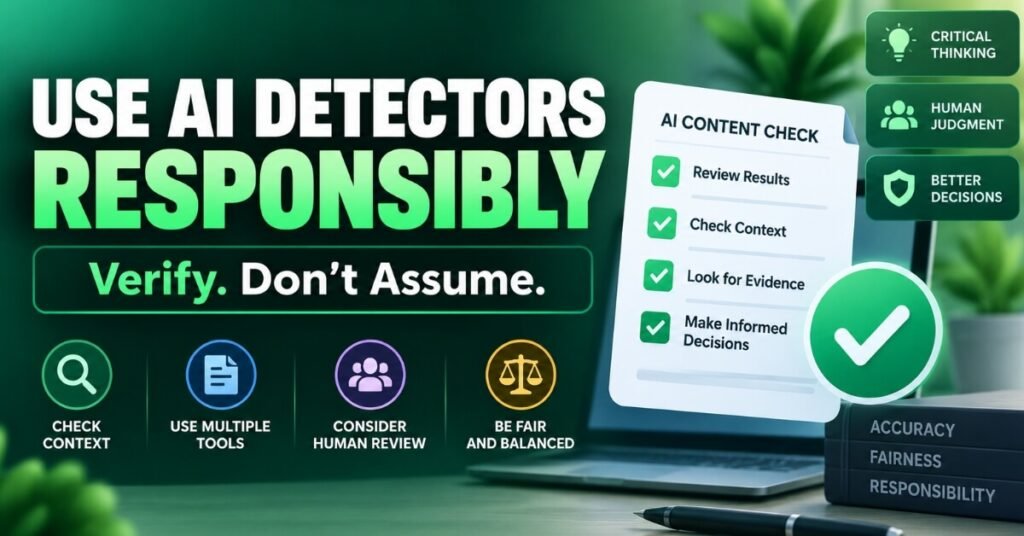
Always combine a detector’s result with your own judgment — don’t treat the score as absolute, unquestionable truth.
If you’re an educator, use detection as a starting point for dialogue with students rather than grounds for immediate punishment.
If you’re a content buyer, ask writers to share their drafting process alongside a detection report for added context.
Re-check important documents with more than one tool, since results can vary noticeably between different detectors.
Keep in mind that detection technology is still evolving, and today’s most reliable tool may need updating within months.
Frequently Asked Questions
Is there a truly free AI detector no sign up option available?
Yes. Several tools, including GPTinf, Clever AI Detector, and Phrasly.AI, provide a genuine free AI detector no sign up experience — you paste your text and get instant results without creating an account.
How accurate are free AI detectors?
Accuracy varies by tool and by how much the text has been edited after generation. Most reputable detectors claim 85–95% accuracy on unedited AI text, but that number drops significantly for heavily revised or paraphrased content.
Can AI detectors be wrong?
Yes. Both false positives (flagging human writing as AI) and false negatives (missing genuine AI writing) are possible outcomes. Always treat results as a strong indicator rather than a final, unquestionable verdict.
Do these tools have any word limits?
Some do, typically ranging from 500 to a few thousand words per scan. Tools like Phrasly.AI stand out for having no strict word limit, making them better suited for checking full-length articles in a single pass.
Can these tools detect content from any AI model?
Most modern detectors are trained to recognize output from major models like ChatGPT, Claude, and Gemini, but detection accuracy can be noticeably less reliable for newer or lesser-known AI tools that haven’t been widely studied yet.
Should schools rely solely on AI detectors for academic decisions?
No. Most educational institutions recommend using detection scores as one piece of evidence among several, combined with direct conversations with students and a review of their drafting or research process.
Are paid detectors more accurate than free ones?
Not necessarily. Some free tools use the same underlying detection models as their paid counterparts, with the main difference being word limits, report formatting, or additional features rather than raw accuracy.
Conclusion
Finding a reliable free AI detector no sign up tool doesn’t have to be complicated or time-consuming. Whether you’re a student double-checking an essay before submission, a blogger verifying freelance content, an educator navigating academic integrity questions, or simply someone curious about a suspicious message online, the tools listed above give you a fast, accessible way to get answers without creating an account or paying a fee. Just remember that no detector is infallible — use these tools as one part of a broader approach to verifying authenticity, and pair them with common sense, context, and, where it matters most, genuine human judgment.
Disclaimer
This article is for informational purposes only. AI detection tools provide probability-based estimates and are not guaranteed to be 100% accurate. Results should not be used as the sole basis for academic, legal, or employment decisions. Always verify important findings through multiple sources and use human judgment alongside any automated tool before taking action.