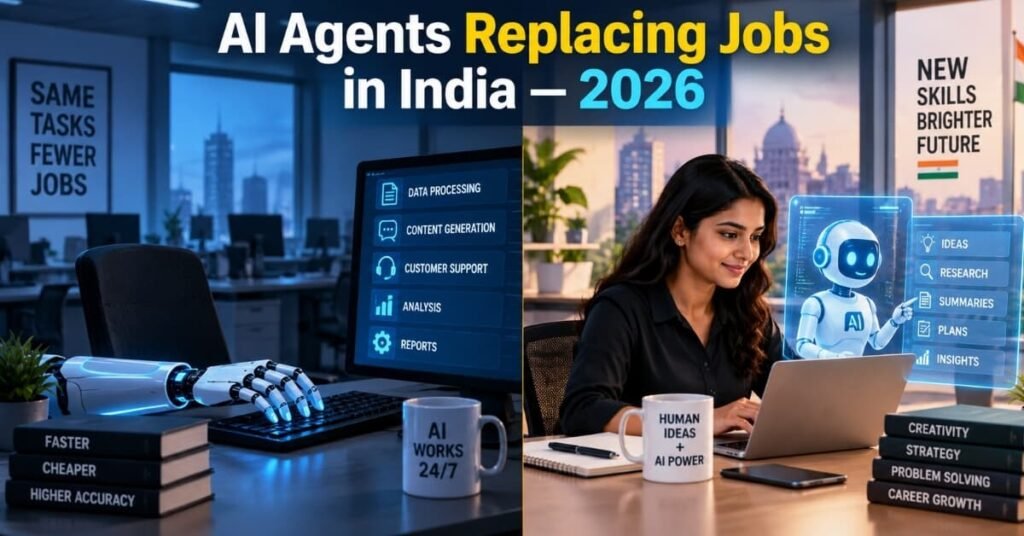
For years, automation felt like a distant threat that mostly worried factory workers. That story has changed. In 2026, AI agents replacing jobs in India has become one of the most searched, most argued about, and most personally felt shifts in the country’s employment landscape. From bank call centers in Mumbai to IT delivery teams in Bengaluru, the same question is being asked in break rooms and WhatsApp groups: is my role next?
This isn’t a hypothetical panic. Indian banks including HDFC, ICICI, and SBI are already using AI voice agents and chatbots to resolve a large share of routine customer queries. Indian IT firms have quietly trimmed thousands of mid-tier positions this year, citing efficiency gains from automation. At the same time, demand for people who can build and manage these very systems has exploded. The picture isn’t simple, and it isn’t one-sided either.
This article breaks down exactly which jobs are most exposed, which ones are considered safer for now, what the data actually shows, and what workers and job seekers in India can realistically do about it.
The Global Backdrop Makes This Harder to Ignore
India isn’t experiencing this shift in isolation. Tech layoffs worldwide have already crossed several thousand roles in just the first weeks of September 2026 alone, with large corporate reductions announced by global companies across ride-sharing, payments, hardware, food delivery, and enterprise software. Trackers monitoring global tech job cuts show the 2026 total already exceeding all of 2025, with automation and AI-driven reallocation cited as a recurring reason across multiple companies.
For Indian workers, this matters because much of the country’s tech and services economy is deeply tied to global clients. When international companies restructure around AI, the ripple effect often lands directly on delivery teams, support centers, and outsourced departments based in India. It’s one more reason this conversation feels urgent rather than theoretical.
Why This Conversation Is Happening Now
AI agents are different from the automation tools of the past decade. Older software followed rigid, pre-programmed steps. Today’s AI agents can read documents, hold conversations, make decisions within set boundaries, and complete multi-step tasks with very little human supervision. That leap in capability is exactly why AI agents replacing jobs in India is no longer a distant forecast — it is a current-quarter business decision for many companies.
Three forces are converging at once:
Cost pressure. Running an AI agent costs a fraction of a monthly salary, and it works around the clock without leave requests.
Maturity of tools. Enterprise-grade AI agent platforms have become reliable enough for real customer-facing and back-office use, not just pilot projects.
Global competitive pressure. Companies serving international clients from India are under pressure to match the productivity gains their competitors are already reporting.
Put together, these forces explain why so many Indian employers are moving from “should we try AI agents” to “how fast can we scale them.”
There’s also a talent-supply angle that doesn’t get discussed as often. India produces one of the largest pools of engineering and technical graduates in the world every year. That scale used to be a straightforward advantage — more graduates meant more capacity for global outsourcing contracts. Now, the same scale means more competition for a shrinking set of entry-level roles that AI agents can already perform reliably, which is pushing new graduates to look for differentiated skills much earlier in their careers than previous generations had to.
Jobs Most at Risk in India Right Now
Not every job faces the same level of exposure. The roles most affected share a common trait: predictable, repetitive tasks with clear rules and large volumes.
1. Data Entry and Document Processing
Intelligent document readers can now extract, verify, and file information from invoices, forms, and contracts without breaks or errors caused by fatigue. This has made basic data entry one of the clearest examples of AI agents replacing jobs in India, particularly in finance, insurance, and logistics back-offices. What used to require a team of five or six people processing paperwork manually can now often be handled by one supervisor overseeing an automated pipeline.
2. Level-1 Customer Support
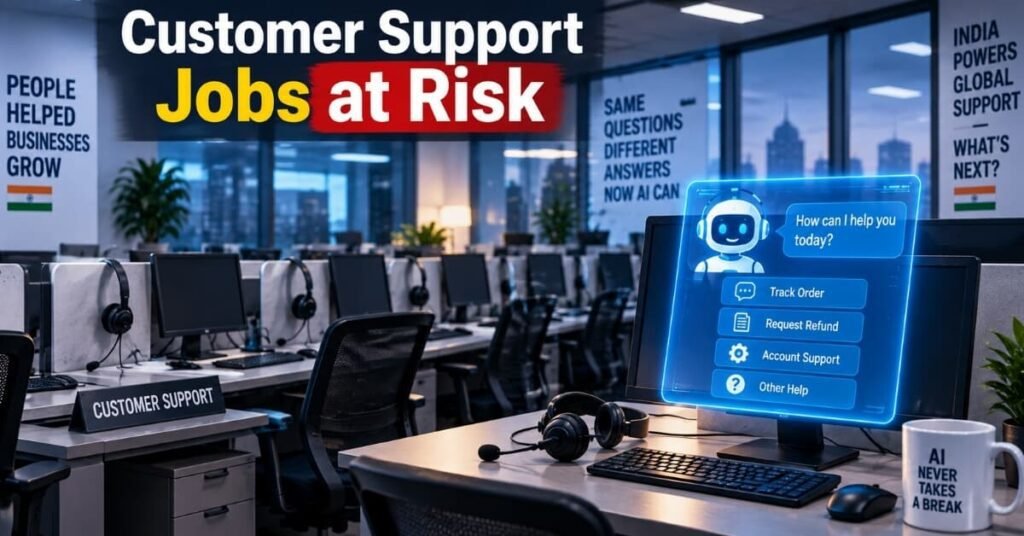
Tier-1 call center work — answering FAQs, resetting passwords, tracking orders, resolving standard complaints — is exactly the kind of task AI voice and chat agents were built for. Several major Indian banks now route a majority of initial customer queries through automated systems before a human ever gets involved. Human agents are increasingly reserved for escalations, complex disputes, and situations that genuinely need empathy or judgement — which means the sheer volume of entry-level support jobs is shrinking even as the remaining roles become more skill-intensive.
3. Junior IT and QA Roles
Routine coding tasks, basic testing, bug triaging, and simple maintenance work are increasingly handled by AI coding agents. This doesn’t mean software engineering is disappearing — but the entry-level rung of that career ladder is getting thinner and harder to climb without additional skills. Fresh graduates who once expected to spend their first year or two doing repetitive maintenance work are now finding those tasks partly automated before they even start.
4. Basic Content and Transcription Work
Transcription, simple copywriting, and templated content production have become far cheaper to automate. Writers who only produce generic, formulaic content are competing directly with tools that can generate similar output in seconds. The writers holding steady are the ones offering original reporting, strong opinion, or genuine subject-matter expertise — things that are much harder for an AI agent to fake convincingly.
5. Administrative and Scheduling Roles
Calendar management, meeting coordination, basic HR queries, and routine reporting are being absorbed into AI-powered workflow assistants across mid-sized and large Indian companies. Executive assistants and office coordinators are increasingly being asked to manage these AI tools rather than perform the underlying tasks manually, which is shifting the role rather than eliminating it entirely — for now.
The Sectors Feeling the Most Pressure
IT Services: India’s IT sector, long considered the backbone of urban middle-class employment, is going through a visible restructuring. Several major firms have reduced mid-tier headcount this year while simultaneously increasing hiring for AI-specific roles. It’s less a story of “AI vs. jobs” and more a story of which skills inside IT are being rewarded.
Banking, Financial Services, and Insurance (BFSI): This sector has moved fastest on customer-facing automation. AI agents replacing jobs in India within BFSI is most visible in call centers, loan processing, and basic compliance checks, where document-heavy, rules-based work is easiest to automate.
Business Process Outsourcing (BPO): India’s BPO industry, which employs millions, is under direct pressure since much of its work is precisely the kind of repetitive, script-based interaction that AI agents handle well.
E-commerce and Logistics: Order tracking, returns processing, and basic seller support queries are increasingly automated, though roles involving physical delivery and last-mile logistics remain far harder to replace.
Retail and Telecom: Customer billing queries, plan changes, and basic troubleshooting are being handled through AI-driven self-service systems, freeing human staff to focus on retention calls, upselling, and complex account issues that require a personal touch.
It’s worth noting that this pattern isn’t unique to India. The same restructuring pressure is visible across the broader technology industry globally, where companies are simultaneously cutting certain roles while racing to hire AI specialists — a trend that’s reshaping how tech companies think about headcount everywhere, not just in outsourcing hubs.
The Other Side of the Story: New Jobs Being Created
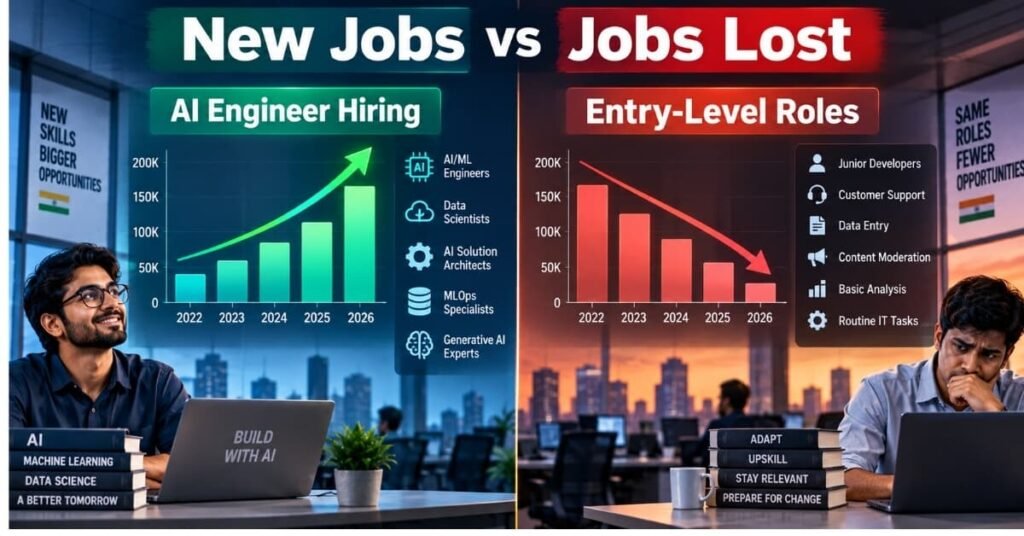
It would be misleading to present this shift as only a story of loss. According to PwC’s 2026 Global AI Jobs Barometer, skills required in the most AI-exposed jobs are changing more than twice as fast as in the least exposed ones, and the most AI-exposed junior roles are now far more likely to demand traditionally senior skills such as leadership and judgement. In other words, jobs aren’t just vanishing — they’re being redefined to require more human capability, not less.
Demand for “agentic AI” engineers — professionals who design, train, and manage AI agent systems — has surged sharply in India this year, with hiring firms reporting triple-digit year-on-year growth in this niche. New categories of work have also opened up around AI oversight: prompt engineering, AI quality auditing, human-in-the-loop review, and AI ethics compliance are all roles that didn’t meaningfully exist in Indian job listings a few years ago.
Even within traditional IT services companies, internal teams are being formed specifically to help clients migrate legacy workflows onto agentic AI platforms. These teams typically pay a premium over standard delivery roles, precisely because the skill combination they require — technical fluency plus an understanding of business processes — is still relatively rare. For workers willing to make the jump, this is one of the more promising on-ramps into higher-value, more automation-resistant work without needing to start a career over from scratch.
This mirrors a global pattern. The broader tech industry itself is being reshaped by forces beyond just automation — supply chains, chip access, and international policy all play a role in how fast AI infrastructure scales. Recent tech export controls have already shown how quickly the rules around AI hardware and talent can shift, which in turn affects how fast Indian companies can deploy the very AI agents replacing jobs in India today.

Jobs That Are Harder to Replace
Roles that depend on judgement, physical presence, emotional nuance, or high-stakes accountability remain comparatively insulated:
Senior decision-makers and strategists — roles requiring context, negotiation, and accountability for outcomes.
Skilled trades and hands-on technical work — electricians, technicians, and field engineers whose work happens in the physical world.
Healthcare providers — doctors, nurses, and therapists, where trust, empathy, and hands-on care matter as much as information processing.
Complex sales and relationship management — especially in high-value B2B deals where trust is built over time.
Creative direction and original strategy — as opposed to templated production, which is far more exposed.
The common thread is clear: the more a job depends on unpredictable human judgement or physical presence, the safer it currently is from AI agents replacing jobs in India.
What Workers Can Actually Do About It
Panic isn’t a strategy, and neither is denial. A few practical moves make the biggest difference:
1.Move up the task ladder. If your daily work is mostly repetitive and rules-based, start deliberately taking on tasks that involve judgement, coordination, or client relationships — the parts AI still struggles with.
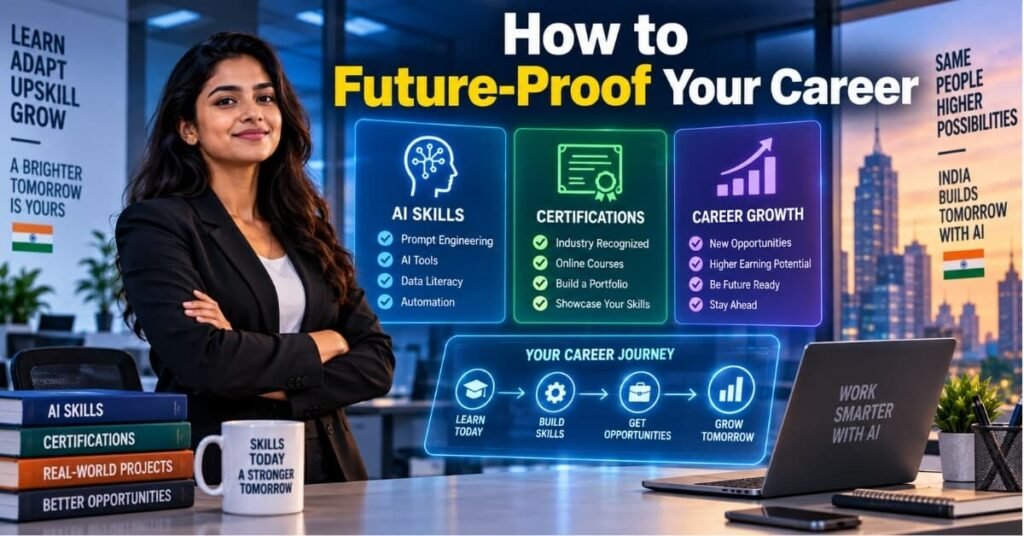
2.Learn to work with AI agents, not against them. Employees who can supervise, prompt, and refine AI-driven workflows are becoming more valuable, not less. Treat AI fluency the way an earlier generation treated basic computer literacy.
3.Specialize instead of generalizing. Deep expertise in a narrow, high-value area is harder to automate than broad, surface-level skills.
4.Build a portfolio of proof, not just a resume. Demonstrable outcomes — projects, case studies, measurable results — carry more weight than job titles alone in an AI-disrupted hiring market.
5.Watch your sector’s specific signals. IT, BPO, and BFSI workers should track internal automation announcements closely rather than waiting for a layoff notice to react.
6.Get comfortable with continuous learning. The half-life of technical skills is shrinking. Short certification courses, hands-on projects, and staying active in professional communities matter more now than a single degree earned years ago.
7.Diversify how you’re findable. Recruiters and hiring managers increasingly search LinkedIn, GitHub, and portfolio sites before they look at a traditional resume. Keeping these updated with recent, relevant work makes a measurable difference.
None of these steps guarantee immunity from disruption, but together they meaningfully shift the odds in a worker’s favor.
What Companies and Policymakers Are Doing
Indian employers are not moving in only one direction. Several large firms have publicly stated they’re pairing workforce reductions in some areas with aggressive reskilling programs in others, particularly around AI literacy and agentic AI development. Industry bodies have also started pushing for clearer government guidance on labor transitions, given how quickly this shift could reshape entry-level hiring pipelines that many first-generation graduates depend on.
At the same time, India’s own AI talent pool is becoming a competitive advantage. The same technical workforce being disrupted by automation is also the one building and exporting these AI systems globally, which is why the net employment picture remains more complicated than a simple “jobs lost” headline suggests.
Frequently Asked Questions
Q1: Which jobs in India are most at risk from AI agents?
Data entry, Level-1 customer support, junior IT and QA roles, basic transcription and content work, and routine administrative tasks are currently the most exposed, largely because they involve repetitive, rules-based work.
Q2: Are AI agents actually replacing jobs, or just changing them?
Both are happening. Some roles are being fully automated, especially at the entry level. Many others are being redefined to require more judgement, oversight, and AI-related skills rather than disappearing outright.
Q3: Is India’s IT sector shrinking because of AI?
Not overall. Several firms have reduced mid-tier headcount in specific functions while increasing hiring for AI, cloud, and data-related roles. The sector is shifting in composition rather than shrinking uniformly.
Q4: What skills should I learn to stay relevant?
Prioritize AI literacy (knowing how to use and supervise AI tools), specialized domain expertise, and soft skills like judgement, communication, and leadership — areas where AI still lags significantly behind humans.
Q5: Will AI agents replace jobs in every industry equally?
No. Roles built around physical presence, empathy, complex negotiation, or high-stakes accountability remain far more resistant to automation than desk-based, repetitive work.
Q6: How fast is this change happening?
Faster than most previous waves of automation. Enterprise AI agent adoption has scaled from pilot projects to mainstream deployment within a single year at many large Indian companies.
Q7: Are fresh graduates more affected than experienced employees?
Often yes, since entry-level tasks tend to be the most repetitive and rules-based. Graduates who build specialized or AI-adjacent skills early tend to fare noticeably better in current hiring cycles.
Q8: Should I be worried if I work in a BPO or call center?
It’s reasonable to be cautious, especially in Tier-1 roles. Moving toward specialized support, team leadership, or quality-and-training roles within the same industry can offer more stability.
Q9: Can government policies slow down AI-driven job losses in India?
Policy can shape the pace and cushion the impact — through reskilling programs, transition support, and labor guidelines — but it’s unlikely to stop the shift entirely, since much of the pressure comes from global competitive forces, not domestic regulation alone.
Q10: Is it too late to switch careers if my current job is at risk?
No. Many workers are successfully moving from at-risk roles (like Tier-1 support or basic data entry) into adjacent, more AI-resistant positions — such as quality assurance, team leadership, or AI-tool supervision — within the same company, often through short internal training programs rather than starting over completely.
Conclusion
The honest answer is that AI agents replacing jobs in India isn’t a single event — it’s an ongoing restructuring that rewards adaptability and penalizes stagnation. Routine, repetitive, and predictable work is genuinely at risk, and pretending otherwise doesn’t help anyone prepare. But the same shift is generating real demand for people who can build, manage, and work alongside these systems. The workers and job seekers who come out ahead won’t necessarily be the most experienced or the most credentialed — they’ll be the ones who moved fastest to adapt their skills to where the actual demand is heading.
Disclaimer
This article is for informational purposes only and reflects publicly available industry trends, reports, and data as of the time of writing. It should not be treated as financial, legal, or career advice specific to your individual situation. Job market conditions can change quickly, and readers are encouraged to consult official industry reports and career professionals before making major employment decisions.