
Introduction
If you have scrolled through tech news in the past few months, you have probably noticed one phrase showing up again and again: AI-Linked Layoffs Across Big Tech. From Oracle to Amazon, from Meta to Microsoft, companies that once bragged about record hiring are now announcing rounds of job cuts, and almost every press release mentions artificial intelligence as the reason. According to outplacement firm Challenger, Gray & Christmas, more than 100,000 U.S. jobs have already been tied directly to AI adoption this year alone, making AI-Linked Layoffs Across Big Tech one of the defining workplace stories of the decade.
This article breaks down what is really happening, which companies are cutting the most roles, why AI is being blamed so often, and what workers can do to protect their careers during this shift. Whether you are an employee worried about your job or a business leader trying to understand the trend, this deep dive into AI-Linked Layoffs Across Big Tech will give you the full picture.
What Exactly Are AI-Linked Layoffs Across Big Tech?
The term AI-Linked Layoffs Across Big Tech refers to the wave of workforce reductions across the technology sector where companies explicitly cite artificial intelligence, automation, or “AI-driven restructuring” as a reason for cutting jobs. Unlike ordinary layoffs caused by a recession or a bad quarter, these cuts are tied to a structural shift in how work gets done. Companies are using AI tools to automate customer support, coding, data entry, marketing copy, and even parts of software engineering that used to require large human teams.
Not every layoff labeled this way is purely about technology, though. Some analysts argue that businesses use AI as a convenient excuse for cuts that were already planned for financial reasons. Even so, the scale and speed of the trend have made AI-Linked Layoffs Across Big Tech impossible to ignore, with technology companies accounting for the largest single share of job losses across every major industry tracked this year.

The Numbers Behind AI-Linked Layoffs Across Big Tech
Data from multiple outplacement and tracking firms paints a clear picture of how fast this trend has grown. In 2025, companies cited AI for roughly 54,800 announced layoffs, a relatively small share of total job cuts. By mid-2026, that number had already nearly doubled, with AI cited in over 100,000 U.S. job cuts through June alone.
The technology sector announced well over 139,000 layoffs during the same period, a jump of more than 80 percent compared with the previous year. The AI layoffs tracker maintained by workforce analysts offers a running, company-by-company breakdown of these numbers for anyone who wants to follow the trend as it develops.
Monthly tracking shows just how volatile the situation has become. Some months saw tens of thousands of cuts explicitly tied to automation, while other months cooled off sharply. Still, the overall direction of AI-Linked Layoffs Across Big Tech has been upward, with AI now cited as the single leading reason for job cuts across industries, ahead of cost-cutting, mergers, and market conditions combined.
Which Companies Are Leading the AI-Linked Layoffs Across Big Tech Trend
Several major names have become closely associated with this year’s job cuts. Oracle announced tens of thousands of position eliminations tied to AI deployment and data center expansion. Amazon trimmed thousands of corporate roles while continuing massive investment in AI infrastructure. Meta cut thousands of positions in divisions like Reality Labs, redirecting spending toward AI research instead. Microsoft reduced its workforce by several thousand employees even as leadership insisted the cuts were not a direct replacement by AI, only a shift in how work gets prioritized.
Smaller but notable players have also made headlines during AI-Linked Layoffs Across Big Tech, including Block, Salesforce, Intuit, and Snap. Block’s CEO was direct about the reasoning, saying AI tools can now handle tasks that once required entire teams. Salesforce leadership similarly said fewer people are needed to run customer service operations because AI systems can manage much of that workload. These companies illustrate a pattern that has become common in AI-Linked Layoffs Across Big Tech: leadership publicly credits AI efficiency gains while quietly consolidating departments.
Interestingly, the same companies driving these cuts are also the ones investing the most heavily in AI acquisitions and partnerships. For example, Nvidia’s Hugging Face acquisition reflects how aggressively hardware and infrastructure giants are consolidating the AI ecosystem, even as many of their industry peers announce job reductions elsewhere. This dual trend of heavy AI investment alongside AI-Linked Layoffs Across Big Tech is one of the more striking contradictions of this moment in tech history.
Beyond the household names, mid-sized companies like WiseTech Global, eBay, Pinterest, and ANGI Homeservices have also announced cuts this year, each pointing to automation and restructuring as part of the reasoning. Even IBM and Atlassian, companies with long histories of steady enterprise growth, have referenced artificial intelligence when explaining recent reductions.
The pattern across nearly every announcement looks similar: a smaller team, a bigger AI budget, and a public statement framing the change as necessary for staying competitive. Some companies have been more transparent than others about the tradeoffs involved, while a few have avoided directly naming AI even when analysts believe it played a role behind the scenes.
Is AI Really Behind These Job Cuts
One of the most debated questions around AI-Linked Layoffs Across Big Tech is whether artificial intelligence is truly the cause, or simply a convenient label. Some executives, including OpenAI’s leadership, have suggested that companies are “AI washing” cuts that would have happened anyway due to overhiring during the pandemic years or general cost discipline. Surveys support this skepticism to some degree, with a notable share of business leaders privately admitting that layoffs framed as AI-driven were actually motivated by financial pressure rather than genuine automation.
At the same time, there is real evidence that AI adoption is changing hiring patterns, especially for younger workers. Employment for people in their early twenties working in AI-exposed occupations has declined noticeably since AI tools became mainstream, while employment for older, more experienced workers in the same fields has held steady or even grown. This suggests that AI-Linked Layoffs Across Big Tech are hitting entry-level and junior positions harder than senior roles, since AI tools are currently better suited to replacing repetitive or foundational tasks rather than complex decision-making.
Career counselors say this generational gap is becoming one of the most sensitive parts of the conversation. Younger graduates entering the workforce today often find fewer entry points into fields like customer support, junior coding, and basic data analysis, roles that used to serve as training grounds for long-term careers. Universities and coding bootcamps are beginning to redesign curricula around this reality, placing more emphasis on skills that sit above the layer automation currently handles well, such as judgment calls, client communication, and cross-team coordination.
Which Sectors Are Hit Hardest
While the technology sector leads the AI-Linked Layoffs Across Big Tech trend by a wide margin, the impact is spreading. Customer service, data entry, junior software development, content writing, and administrative support roles across multiple industries have all seen reductions tied to automation. Retail, finance, and even parts of healthcare administration have started citing AI-driven efficiency as a reason for smaller headcounts.
Analysts warn that if the current pace continues, AI-Linked Layoffs Across Big Tech could extend well beyond tech into logistics, insurance, and professional services over the next few years. A growing number of organizations piloting autonomous business tools have already reduced their workforce as a direct result, even though researchers have found no clear link between those reductions and improved return on investment. This gap between expectation and actual results is a detail often missing from headlines about AI-Linked Layoffs Across Big Tech, and it is one reason experts encourage readers to look past the headline numbers before drawing conclusions.
Retail workers, insurance staff, and finance professionals are increasingly asking the same questions about job security that technology employees have faced throughout AI-Linked Layoffs Across Big Tech.
Lessons From Previous Waves of Automation
This is not the first time a new technology has triggered fear about mass job loss. The introduction of personal computers, the rise of the internet, and the shift to cloud computing all sparked similar predictions decades ago, and each time, a portion of those predictions came true while new categories of work emerged to replace what was lost. What makes the current wave different is the speed at which it is unfolding.
Earlier shifts played out over ten or twenty years, giving workers and institutions time to adjust curricula, retrain staff, and build new industries around the change. This time, large language models and automation tools have gone from experimental products to boardroom priorities in a matter of a few short years, leaving far less runway for adaptation.
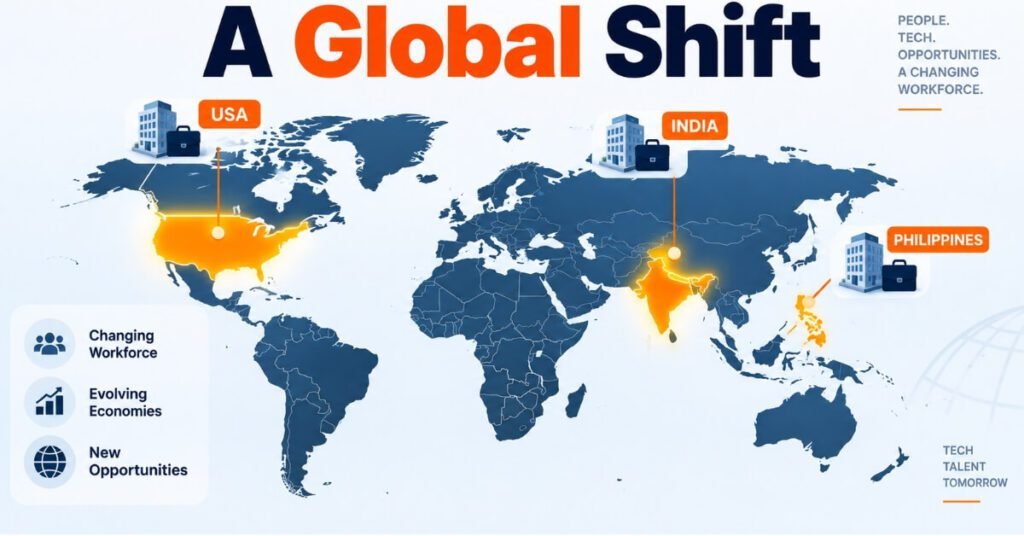
Economists studying this period point out that the winners and losers are not evenly distributed. Workers with deep domain expertise, strong communication skills, or roles that require in-person trust, such as healthcare providers or skilled tradespeople, appear far more insulated than workers in repetitive digital tasks. Meanwhile, countries and regions with large outsourcing and business process industries, including India and the Philippines, are watching closely, since much of their economic growth over the past two decades has depended on exactly the kind of standardized digital work that automation tools are now best suited to replace.
Global staffing firms report early signs of slower hiring in these markets, even as local governments push training programs aimed at helping workers transition into higher-skill technology roles.
How Workers Can Prepare for AI-Linked Layoffs Across Big Tech
For employees worried about job security, there are practical steps that can help during this period of AI-Linked Layoffs Across Big Tech. First, focus on skills that complement AI tools rather than compete with them, such as strategic thinking, client relationships, and complex problem-solving that automation cannot easily replicate. Second, learn to use AI tools directly in your current role, since employees who can operate alongside automation are often seen as more valuable than those who avoid it.
Third, diversify your professional network and stay visible in your industry, since referrals and relationships often matter more than ever when hiring slows down. Fourth, keep an emergency fund and updated resume ready, because the speed of AI-Linked Layoffs Across Big Tech announcements has left many workers with very little advance notice. Finally, pay attention to which departments and skill sets are being protected at your company, since this can offer early warning signs before formal announcements are made.
What the Future Holds
Predictions about where AI-Linked Layoffs Across Big Tech will lead vary widely depending on who you ask. Some technology leaders, including voices from companies like Anthropic, have warned that AI could eliminate a significant share of entry-level white-collar jobs within the next few years. Others argue that new roles will emerge just as quickly as old ones disappear, pointing to previous waves of automation that ultimately created more jobs than they destroyed, even if the transition was painful for those affected in the short term.
What seems clear is that AI-Linked Layoffs Across Big Tech mark a turning point rather than a temporary blip. Companies are restructuring not just their headcount but their entire approach to how work gets planned, assigned, and measured. For job seekers, business leaders, and policymakers alike, understanding the real drivers behind AI-Linked Layoffs Across Big Tech will be essential for making informed decisions in the years ahead.

What This Means for Business Leaders and Recruiters
For executives and hiring managers, this shift creates a different kind of challenge. Cutting headcount too aggressively without a clear plan for maintaining output quality can backfire, leading to burnout among remaining staff and slower delivery on key projects.
Some companies that moved quickly to automate customer support, for example, later faced customer satisfaction complaints and had to rehire specialized staff to fix issues that automated systems could not resolve on their own. Recruiters are also adjusting their approach, screening candidates more heavily for AI literacy and adaptability rather than relying solely on traditional credentials or years of experience.
Human resources teams are increasingly building internal training programs to help existing staff transition into new roles rather than losing institutional knowledge through repeated rounds of cuts. Boards and investors, meanwhile, are watching closely to see whether promised efficiency gains from automation actually translate into stronger margins, since several independent studies this year found little measurable link between workforce reductions tied to automation and improved financial performance. This disconnect between expectation and outcome is likely to shape how cautiously companies approach further restructuring decisions going into next year.
Frequently Asked Questions
What is causing AI-Linked Layoffs Across Big Tech?
Companies are citing artificial intelligence adoption, automation of routine tasks, and restructuring around AI infrastructure as the primary reasons for job cuts this year, although some of these cuts are also linked to broader cost-cutting efforts.
Which companies have announced the most job cuts this year?
Oracle, Amazon, Meta, Microsoft, Block, and Salesforce are among the companies most frequently mentioned in connection with this year’s workforce reductions.
Are AI-Linked Layoffs Across Big Tech only happening in the tech industry?
No. While technology companies account for the largest share, sectors like retail, finance, and healthcare administration have also started citing AI-driven efficiency as a reason for reducing headcount.
Is AI actually responsible for all these layoffs?
Not entirely. Some executives and surveys suggest that companies use AI as a convenient explanation for cuts that were already planned for financial reasons, though genuine automation is also playing a real role.
How can I protect my job during this trend?
Building skills that complement AI tools, learning to use automation directly in your role, staying visible in your professional network, and keeping financial and career backup plans ready are all practical steps.
Will new jobs eventually replace the ones being cut?
History suggests some new roles will emerge, particularly around building, managing, and overseeing AI systems, but there is no guarantee the transition will be smooth or that displaced workers will easily move into these newer positions without retraining.
Which age group is most affected by this trend?
Data suggests younger workers in entry-level, AI-exposed roles have seen the steepest employment declines, while more experienced workers in similar fields have generally held on to their positions or even seen growth.
Conclusion
AI-Linked Layoffs Across Big Tech have reshaped conversations about work, technology, and career security in ways few expected even a year ago. What started as scattered headlines about a handful of companies cutting jobs has grown into one of the defining economic stories of the year, with more than 100,000 positions tied directly to artificial intelligence adoption through the first half of 2026 alone. Whether AI is the true driver or simply a convenient label for broader cost-cutting, the practical impact on workers is real, and the trend shows little sign of slowing down.
Staying informed, adapting skills, and watching how companies balance AI investment against workforce reductions will help anyone navigate this shifting landscape with more confidence. As more data becomes available in the coming months, the picture will likely become clearer, but for now, the safest approach for both workers and business leaders is to treat every headline with a healthy dose of scrutiny while still taking practical steps to prepare for a workplace that looks increasingly different from the one that existed just a few years ago.
Disclaimer
This article is based on publicly available data, news reports, and industry trackers current as of the time of writing. Layoff numbers and company statements can change rapidly, and readers should verify the latest figures directly from primary sources before making career or business decisions. This content is for informational purposes only and does not constitute financial, legal, or career advice.