
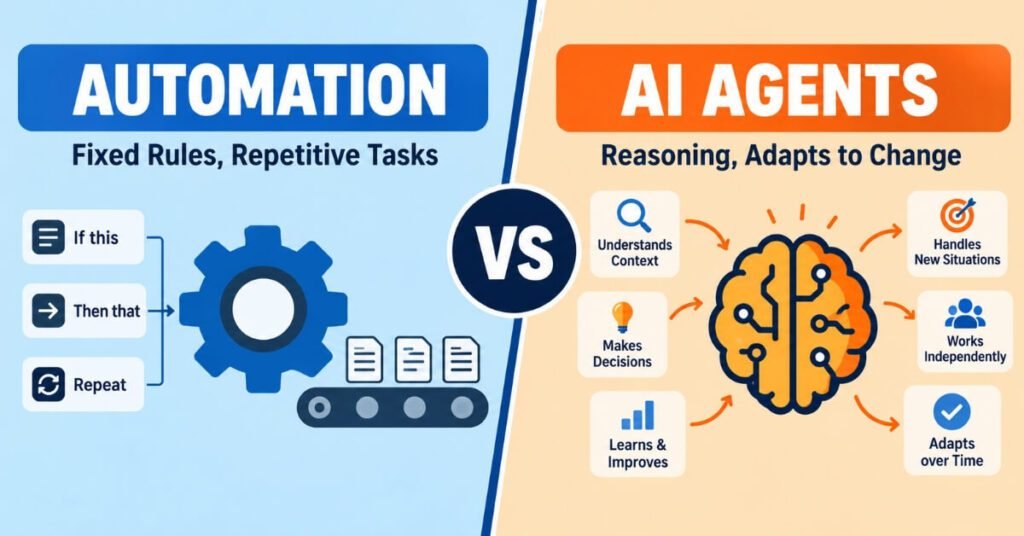
If you have spent any time researching modern workflow tools, you have probably run into the debate around AI Agents vs Automation more than once. Business owners, marketers, and even solo bloggers are asking the same question: should you stick with rule-based automation, or is it time to move to something smarter? This confusion is completely understandable because both terms get thrown around loosely on YouTube, LinkedIn, and Reddit, often without a clear explanation of what separates them.
In this guide, we will break down AI Agents vs Automation in plain, simple language, using real examples anyone can relate to — no confusing jargon, no unnecessary technical detail. By the end, you will know exactly which one fits your situation, whether you run a small business, manage a content site, or just want to automate your personal tasks.
This topic matters more in 2026 than it did even a year or two ago, simply because the tools have matured so quickly. A few years back, “automation” and “AI” were almost separate worlds — automation platforms handled repetitive triggers, while AI models mostly lived inside chatbots or research demos. Today, those two worlds overlap constantly. Almost every popular automation platform now offers some kind of AI-powered step, and almost every AI agent framework leans on structured automation behind the scenes to stay efficient. Understanding where one ends and the other begins helps you avoid overpaying for complexity you don’t need, or underbuilding a system that can’t keep up with real-world demands.
What Is Automation, Exactly?
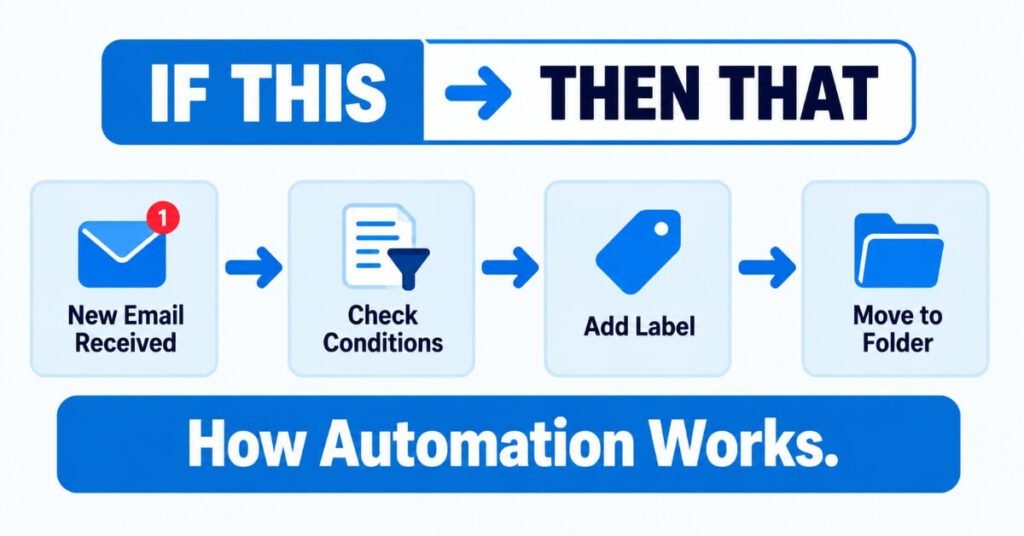
Traditional automation is built on fixed, predefined rules. You set up a trigger, and the system follows a strict “if this happens, then do that” instruction every single time. Think of email autoresponders, scheduled social media posts, or a spreadsheet macro that formats data automatically. There is no thinking involved — just consistent, repetitive execution of the exact steps you programmed, which is the most basic starting point for understanding AI Agents vs Automation.
Automation tools like Zapier, Make, or basic WordPress plugins fall into this category. They are fast, predictable, and extremely reliable for tasks that never change. The moment a task requires judgment or adapts to unexpected input, though, plain automation tends to break down or simply stop working correctly, which is exactly where the AI Agents vs Automation conversation usually begins.
This is not a flaw in automation — it is exactly how it was designed to work. A washing machine does not “think” about how dirty your clothes are; it runs the exact cycle you selected, every single time, regardless of the load. That predictability is a feature, not a limitation. Businesses rely on this kind of consistency for payroll processing, invoice generation, appointment reminders, and thousands of other repetitive back-office tasks that simply need to happen the same way, over and over, without fail.
The downside shows up the moment conditions change even slightly. If a form field is left blank, if a customer types their request in an unexpected format, or if a new product category doesn’t fit the existing rule set, a purely automated system either throws an error, skips the task, or produces an incorrect result. Someone then has to step in manually to fix it, which defeats part of the purpose of automating the task in the first place. This is precisely the gap in the AI Agents vs Automation comparison that has pushed so many businesses to start exploring smarter alternatives.
It’s also worth noting that automation isn’t a single tool — it’s really a category. Simple automation might be a single “if this, then that” trigger inside an email marketing tool. More advanced automation platforms let you chain together dozens of steps, add conditional branches, and pull data from multiple apps at once. Even in these more advanced setups, though, every branch and condition still has to be manually anticipated and written out ahead of time by a human. The system never truly “figures out” anything on its own; it simply follows the most detailed instruction set you gave it.
What Is an AI Agent?
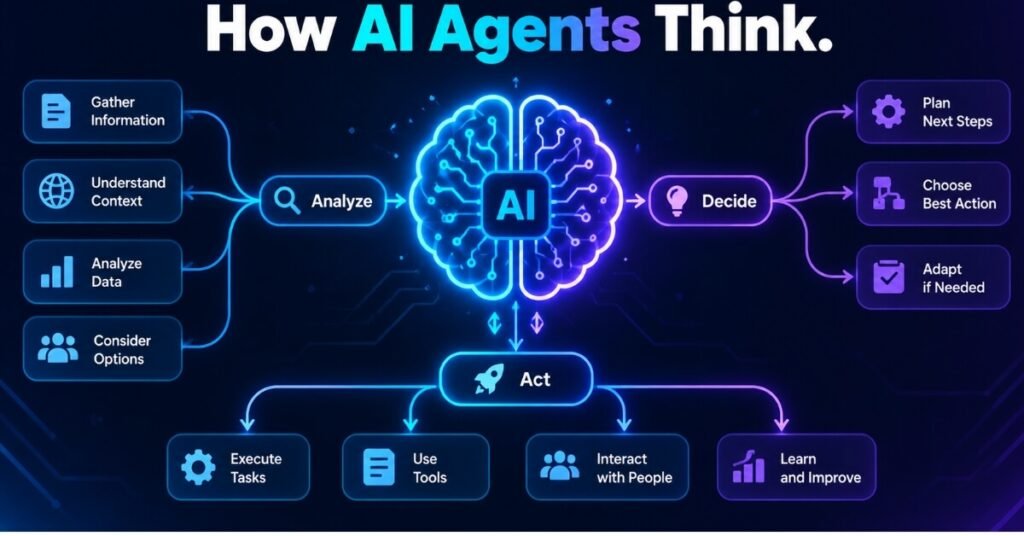
An AI agent, on the other hand, is designed to reason, plan, and make decisions on its own. Instead of following one rigid path, it can evaluate a situation, choose from multiple possible actions, and adjust its approach based on new information. This is the core reason people keep comparing AI Agents vs Automation — the underlying philosophy is completely different.
For example, an AI agent handling customer support could read a message, understand the intent behind it, decide whether to escalate, answer directly, or pull data from another system, all without a human writing out every single branch of logic in advance. This flexibility is exactly what separates modern AI agents from older automation scripts.
Under the hood, most AI agents combine a large language model with some form of memory, a set of tools it is allowed to use, and a goal it is working toward. Instead of following one hardcoded script, the agent breaks a goal down into smaller steps, decides what information it needs, fetches that information using its available tools, and then figures out the next move based on what it just learned. This loop of “observe, think, act” is exactly what separates AI Agents vs Automation in practice, allowing an agent to handle situations nobody explicitly programmed for in advance.
That said, AI agents are not magic. They can still make mistakes, misinterpret instructions, or take an inefficient path to a goal if they are not set up with the right guardrails. Good agent design usually involves clear boundaries on what the agent is allowed to do, checkpoints where a human can review its decisions, and fallback behavior for situations where it genuinely doesn’t know what to do next.
It also helps to understand that not every AI agent looks the same. Some are extremely narrow, built to handle just one type of decision, like routing support tickets to the right department. Others are far broader, capable of juggling several tools, multiple data sources, and long chains of reasoning to complete a multi-step project almost independently. The narrower the agent’s job, the easier it usually is to build, test, and trust in production — another practical detail worth remembering in any AI Agents vs Automation discussion.
AI Agents vs Automation: The Core Differences
When people search for AI Agents vs Automation, they are usually trying to understand a few key distinctions. Let’s break them down one by one.
1. Logic and Flow
Automation runs on rigid, pre-written instructions. AI agents use goal-oriented reasoning, meaning they figure out the best next step themselves instead of following a script line by line.
2. Handling Unexpected Data
Automation needs clean, structured input to function correctly; feed it something unusual and it often fails silently. AI agents can interpret messy, unstructured input — like a customer’s casual message or an oddly formatted document — and still produce a useful result.
3. Adaptability
Automation stays exactly the same until a human manually edits it. AI agents can adjust their behavior as conditions change, without needing constant manual updates.
4. Cost and Complexity
Automation is generally cheaper to set up and maintain for simple, repetitive tasks. AI agents require more setup, more computing power, and often a bit of trial and error before they perform reliably, which matters when weighing AI Agents vs Automation for a smaller budget.
5. Error Handling
When automation hits something it can’t handle, it typically fails outright — the workflow stops, or it silently skips the step, and someone has to notice and fix it manually. An AI agent, by contrast, can often recognize that something is off, try an alternative approach, or ask a clarifying question before proceeding, which reduces the number of broken workflows a team has to babysit.
6. Transparency and Predictability
One underrated point in this comparison is that automation is fully transparent — you can trace every single step back to the exact rule that triggered it. AI agents, especially more advanced ones, can sometimes behave in ways that are harder to predict step-by-step, even if the end result is usually correct. This trade-off between flexibility and predictability is a real consideration for teams operating in regulated industries.
Understanding these differences is the real starting point of any AI Agents vs Automation decision, because picking the wrong one for your task can waste both time and money.
AI Agents vs Automation: Real-World Examples
Let’s look at how this plays out in actual business situations, since theory alone rarely makes the AI Agents vs Automation choice easier.
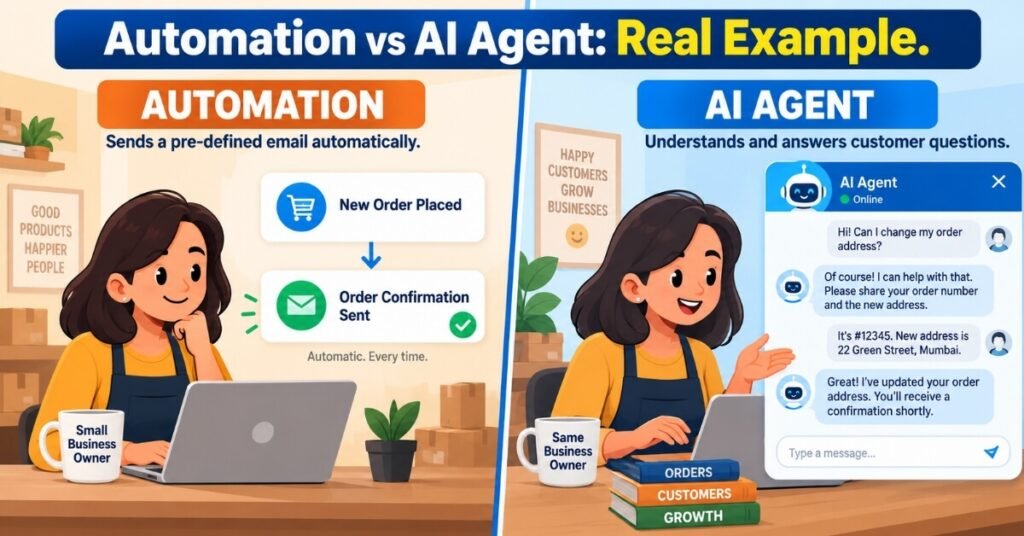
A small online store might use plain automation to send an order confirmation email the moment a purchase is made — this never needs to change, so automation is perfect. But if that same store wants a system that can answer customer questions about order status, suggest similar products, and handle returns conversationally, that calls for an AI agent instead. This exact scenario is one of the clearest, most common examples of AI Agents vs Automation playing out in a real business.
Content creators face a similar decision. Scheduling a blog post to publish at a set time is a job for automation. But researching trending topics, drafting an outline, and adjusting tone based on audience feedback is a task better suited to an AI agent, since it involves judgment rather than a fixed sequence of steps.
Finance teams offer another useful example. A rule-based automation can flag any expense report over a fixed dollar amount for manual review — simple, predictable, effective. But if a company wants a system that reviews the context of an expense, checks it against past spending patterns, and only flags genuinely unusual cases while auto-approving routine ones, that level of judgment calls for an agent-based approach instead — another clear example of AI Agents vs Automation in a real business setting.
Even in healthcare and logistics, the same pattern repeats. Appointment reminders and shipment tracking updates are perfect candidates for straightforward automation because the logic never really changes. Triage-style decisions, rerouting a delayed shipment around unexpected weather, or prioritizing which support tickets need urgent attention, however, all benefit from a system capable of weighing multiple factors at once rather than following one fixed rule.
For a more technical, vendor-neutral breakdown of how these two systems are architected under the hood, Amazon Web Services’ comparison of AI agents and automation is worth reading, especially if you’re evaluating enterprise-grade tools rather than simple no-code platforms.
In short, the AI Agents vs Automation comparison usually comes down to one simple test: does the task require judgment, or does it just require repetition?
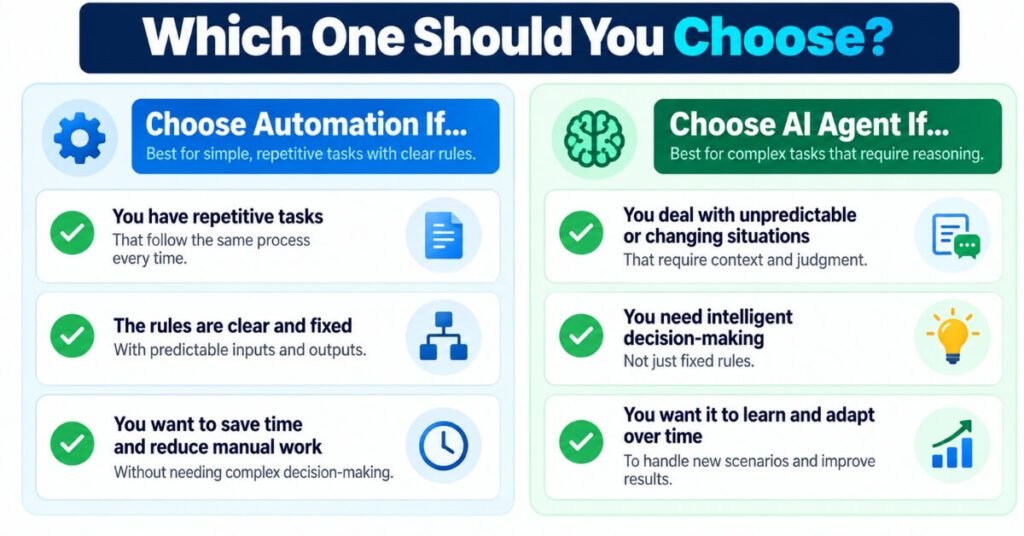
AI Agents vs Automation: Which One Should You Choose?
There is no universal winner in the AI Agents vs Automation conversation — the right choice depends entirely on your specific task.
Choose automation if your task is repetitive, predictable, and rarely changes. It is cheaper, faster to build, and far easier to troubleshoot when something goes wrong. For things like data entry, scheduled posting, or simple notifications, automation remains the smarter and more cost-effective option.
Choose an AI agent if your task involves decision-making, unpredictable input, or multiple possible outcomes. Customer support, content research, and complex workflow management are areas where an agent’s flexibility genuinely pays off, even though it takes more effort to set up initially.
Many businesses eventually land somewhere in the middle, using automation for the boring, repetitive parts of a workflow while layering an AI agent on top for the parts that require actual thinking. This hybrid approach is quickly becoming the standard answer to the AI Agents vs Automation question, rather than picking just one side.
Budget and technical comfort also play a role in this decision. A solo blogger or small business owner with limited technical resources may find that a handful of simple automations covers 80% of their needs, with just one or two AI agents handling the trickier, judgment-based tasks. Larger teams with dedicated developers, on the other hand, may build more elaborate agent systems that handle entire workflows end-to-end, stepping in with automation only for the most rigid, high-volume steps. This size-based split is one more angle worth factoring into any AI Agents vs Automation decision.
A practical way to decide is to map out your workflow on paper first. List every step, then mark which ones are truly repetitive and unchanging versus which ones require a judgment call. The repetitive ones almost always belong to automation, while the judgment-based ones are where an agent earns its cost.
If you’re already experimenting with AI tools for content and social distribution, it’s worth reading our related guide on Instagram’s first-party AI drafting tools and Android alternatives, which walks through a similar decision-making process for choosing the right AI tool for social content.
The Future of AI Agents vs Automation
Looking ahead, the line between the two is expected to blur even further. Automation platforms are increasingly adding AI-powered decision nodes, while AI agent frameworks are borrowing structured, rule-based components from traditional automation to stay predictable and safe. This convergence means the AI Agents vs Automation discussion may eventually feel outdated, replaced by hybrid systems that pick whichever approach fits a given step automatically.
Some industry analysts predict that within the next few years, most no-code platforms will simply offer a single unified builder where you drag in either a “rule” block or a “reasoning” block depending on what a step needs, without forcing users to think about which underlying technology powers it. That shift would make tool selection far less stressful for beginners who currently feel overwhelmed trying to pick the “right” option before even starting a project.
For now, though, understanding the practical differences between AI Agents vs Automation is still essential for anyone building workflows, whether you’re a solo blogger, a small business owner, or part of a larger team evaluating new tools.
Common Mistakes People Make
One frequent mistake is assuming an AI agent is always the “better” choice simply because it sounds more advanced. In reality, using a complex AI agent for a task that automation could handle perfectly well just adds unnecessary cost and risk of errors. Another common mistake is trying to force rigid automation onto a task that genuinely needs judgment, which usually results in a broken or frustrating user experience. Both mistakes stem from the same root cause: skipping the basic AI Agents vs Automation evaluation before building anything.
A third mistake is skipping the testing phase entirely. Whether you deploy a simple automation or a full AI agent, it needs to be tested against real, messy, unpredictable inputs before it touches actual customers or critical business data. Skipping this step is how businesses end up with automations that quietly fail for weeks before anyone notices, or agents that make confidently wrong decisions because nobody checked their output early on — a costly oversight in any AI Agents vs Automation rollout.
A fourth common mistake is neglecting documentation. Even a “smart” AI agent should have clear notes on what it’s supposed to do, what tools it has access to, and what its limits are. Without this, troubleshooting becomes a nightmare the moment something unexpected happens, since nobody remembers exactly how the system was originally set up.
The smartest approach is always to match the tool to the task, not the other way around.
Frequently Asked Questions
Q1. Is an AI agent the same thing as automation?
No. While both can perform tasks without constant human input, automation follows fixed rules, while an AI agent can reason and adapt. This is the central point in any AI Agents vs Automation comparison.
Q2. Which is cheaper, AI agents or automation?
Automation is generally cheaper to build and maintain for simple, repetitive tasks. AI agents cost more upfront but can save time on complex tasks where automation would fail.
Q3. Can I use both AI agents and automation together?
Yes, and many businesses do exactly this. A hybrid setup, where automation handles simple steps and an AI agent handles decision-making steps, is often the most practical answer to the AI Agents vs Automation debate.
Q4. Do I need coding skills to build an AI agent?
Not necessarily. Many no-code and low-code platforms now let you build basic AI agents without deep technical knowledge, though more advanced agents still benefit from some coding experience.
Q5. Which one should a beginner start with?
If you are new to workflow building, start with simple automation first to understand the basics, then experiment with AI agents once you have a task that clearly requires judgment or flexibility.
Q6. Will AI agents completely replace automation someday?
Unlikely, at least in the near future. Even the most advanced AI agent systems still rely on structured automation for their most repetitive sub-tasks because it’s cheaper and faster than involving an AI model for every tiny step. The two are more likely to keep merging into hybrid systems rather than one fully replacing the other in the AI Agents vs Automation landscape.
Conclusion
The AI Agents vs Automation debate isn’t really about which technology is “better” overall — it’s about matching the right tool to the right job. Automation remains unbeatable for repetitive, predictable tasks, while AI agents shine when a task needs judgment, flexibility, or the ability to handle messy, unexpected input. As these two technologies continue to blend together, the smartest move is to stay flexible and use whichever approach actually solves your problem, rather than getting stuck picking a side.
Whatever you decide, start small, test thoroughly, and let the complexity of your actual task — not hype or trends — guide your final choice.
Disclaimer
This article is intended for general informational purposes only. Tool names, pricing, and capabilities mentioned above may change over time, and readers should verify current details directly with the respective providers before making any business or purchasing decisions. This content does not constitute professional or technical consulting advice.